



11 min read · November 26, 2026
Speed to Lead With an AI Setter: What We Learned Running CloseBot
 By Esteban AndradeFounder of Hesel Media
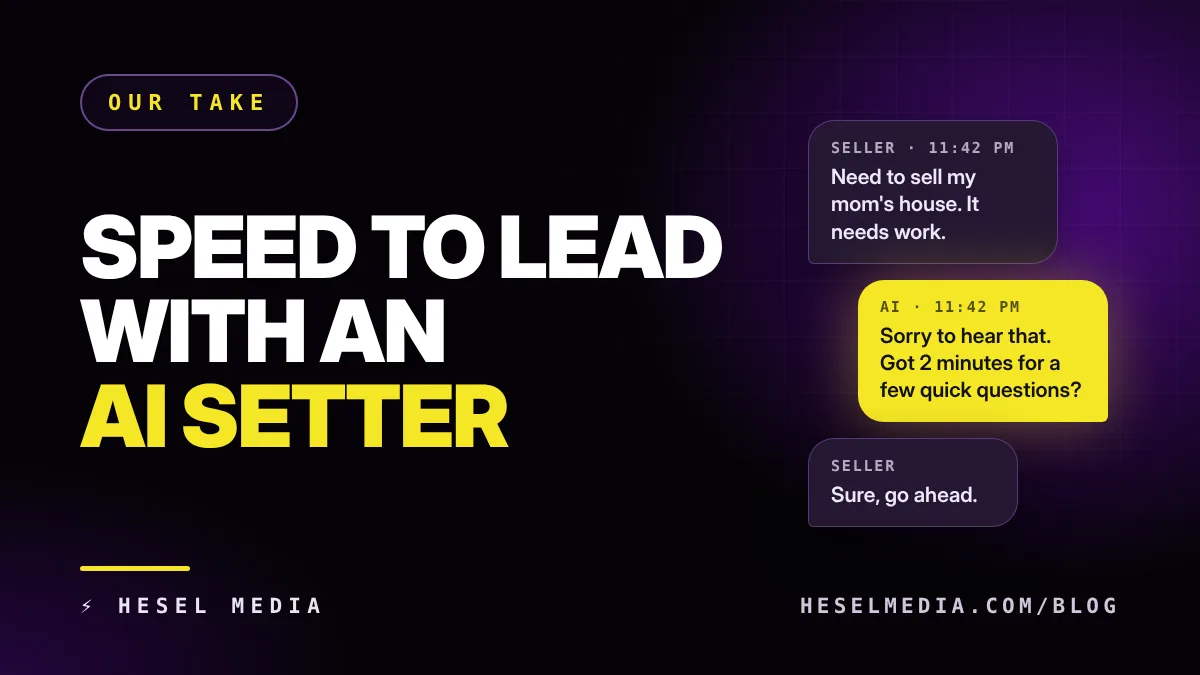
A seller fills out your form at 9:40 on a Saturday night. Your acquisitions rep is at dinner. By Monday morning, two other investors have texted back and one has a walkthrough booked. You paid for that inquiry. You lost the conversation while you slept.
That gap is the job an AI appointment setter like CloseBot was built for. We set CloseBot up inside our own agency in 2024. Below is what it does, what it costs, where it helped us, and where a human still had to step in.
Disclosure: Esteban Andrade, Hesel's founder, is friends with CloseBot's co-founder and CEO, Bryce DeCora. Hesel has used CloseBot in its own sales process. Read our take with that in mind.
Key points
- CloseBot is an AI appointment setter: it texts back new inquiries, asks qualifying questions, follows up and books appointments on your calendar inside CRMs like GoHighLevel and HubSpot.
- It closes the reply gap at night and on weekends. It does not replace the first human call, which is still the number to measure.
- Business plans start free for 100 AI replies a month. The Core plan ran $97 to $297 a month for 100 to 5,000 replies as of November 26, 2026.
- Our biggest lesson: one clear goal, short instructions and a weekly read of real conversations beat a long, clever prompt.
- Best fit: teams with steady inbound inquiries and after-hours gaps. Poor fit: teams that need an AI to dial, or that have not finished A2P registration and consent.
Our verdict in one paragraph
CloseBot is the AI setter we point investors to when they run on GoHighLevel and want a text conversation started in seconds. It is not a dialer and not a closer. Pair it with a person who calls fast, and it covers the hours your team is offline. Skip it if nobody on your team will spend an hour a week reading what it says to sellers.
What is CloseBot?
CloseBot is an AI appointment setter that replies to new inquiries by text, qualifies them, follows up and books appointments on your calendar. Bryce DeCora is its CEO and co-founder. It connects to GoHighLevel, HubSpot and its own CRM, and it can also run with other stacks.
The parts that matter for an investor team:
- Agent builder and testing portal. You write the agent's instructions and test conversations before any seller sees them.
- Human takeover. Anyone on your team can jump into a conversation, and you can roll back a change to the agent.
- Smart FAQ. When a seller asks something the agent cannot answer, it flags the question and follows up once a person adds the answer.
- Real estate tools. CloseBot lists property data and drive-time checks among its built-in industry tools.
CloseBot's homepage claims more than 1.4 million booked appointments and more than 150,000 messages a day. Those are the vendor's numbers, not ours. Its site describes the agent as working across text-based channels, so plan on a different tool if you want an AI that places phone calls.
Why speed to lead needs an AI and a human
Speed to lead is won by the first useful conversation, and an instant AI text plus a fast human call covers more hours than either one alone. The research on response time is old and not about home sellers, so we lay out its limits in our speed to lead statistics breakdown. The direction is clear: whoever talks to the seller first has the edge.
Our ISA standard is a first dial within 2 minutes, 5 at most. People keep set hours. Inquiries do not. A seller who fills out a form at 11 p.m. gets nothing from a call team that starts at 9 a.m., and that is the hole an AI setter fills.
Two setups from operators on our Office Hours stuck with us:
- The 10-minute rule. One operator sends a text and an email the instant an inquiry lands. If the seller replies and nobody on his team answers within 10 minutes, AI agents take over the conversation.
- Who goes first depends on the channel. A guest who builds AI setters put it this way: on expensive channels like PPC, TV and radio, humans call first and AI follows up. On colder, cheaper sources, AI goes first and humans follow.
For the full first-call system, read our speed to lead playbook for investors. This post covers the AI half.
What we learned running CloseBot in our own agency
Running CloseBot on our own sales pipeline taught us that the setup work, not the AI model, decides whether it books good appointments. Here is what we did and what we would tell any team starting today.
We tested it on our own calendar first
In January 2024 we built "CloseBot for the Agency" as an internal project. Our operations manager loaded CloseBot's GoHighLevel snapshot, connected it to the account where our own inquiries land, and booked a session on Bryce's office hours to get the setup right.
By May 2024 the bot was booking test appointments straight onto a sales rep's calendar. Each one fired a Slack alert that read "Scheduled by Closebot," with the contact link, so a person saw every AI booking within seconds. We ran internal test contacts through it for weeks.
Objectives beat long prompts
Our first version leaned on prompts: why the conversation is happening, how to respond, and a page of business details. Then we added objectives, such as confirming a monthly marketing budget before booking. Early on the bot still went off script at times, and we recorded one bad conversation for CloseBot's support team. The lesson we took: tighter instructions, not more of them.
CloseBot's own CEO gives the same advice in a July 2026 post: shorter instructions keep the model more consistent. For an investor, that means one goal (a booked call with a qualified seller) and four or five facts the bot must learn on the way there.
Tag every AI booking by source
In May 2024 our operations manager asked a fair question: what do we do with intro calls booked through other paths, such as a setter, CloseBot, reactivation campaigns or social outreach? The answer was a source tag on every booking. Without it, you cannot tell whether AI-booked appointments show up and sign at the same rate as the ones your ISA books.
Why we pick it over GoHighLevel's built-in bot
When we map out a system for an investor already on GoHighLevel, Esteban has recommended CloseBot over the platform's native AI bot for qualifying and booking. We pair it with a call team that dials new inquiries within minutes, because the text is the opener and the call is where trust gets built.
Bryce makes his own case in that July 2026 post. He points to choosing the AI model, splitting replies into short texts, and custom tools like a drive-time check before booking. He also concedes that running everything on one platform is convenient. That is a fair trade to weigh.
Esteban's take on the founder
Esteban's take: Bryce is a rare founder who can write the code, ship the product and sell it. You can see it in how fixes land. In the same post, CloseBot describes a date calculation bug and the weekday check it added before every booking to stop it.
CloseBot pricing as of November 26, 2026
CloseBot prices business plans by monthly AI replies, with message costs included in the plan. These are the monthly prices we saw on CloseBot's plans page on November 26, 2026.
| Plan | AI replies a month | Price (monthly billing) | Notes |
|---|---|---|---|
| Free | 100 | $0 | 1 team seat, unlimited AI agents |
| Core | 100 | $97 a month | 7-day trial, unlimited team seats, 24/7 human support |
| Core | 1,000 | $147 a month | Same features, more replies |
| Core | 2,000 | $197 a month | Same features, more replies |
| Core | 5,000 | $297 a month | Higher tiers run to 100,000+ replies |
| Growth | High volume | Custom quote | SLAs, HIPAA, quarterly audits |
Annual billing costs less: Core at 100 replies showed as $970 a year. Plans run month to month with no contract, and CloseBot's page states plainly that there are no refunds, so use the free plan and the 7-day trial to test. Agencies are billed $0.012 per message, which they can re-bill to clients.
How many replies does an investor team need?
Multiply your monthly inquiries by the average number of AI replies per conversation. Say you get 120 seller inquiries a month and the bot averages 12 replies per conversation. That is 1,440 replies, which lands in the 2,000-reply tier at $197 a month. The 12 is our assumption for the example, so count your own for two weeks before you pick a tier.
The break-even math
At $197 a month, CloseBot costs $2,364 a year. If it saves one contract a year that would have gone cold overnight, and that contract earns more than $2,364, it paid for itself. For most operators the bigger cost is not the subscription. It is the hour a week someone must spend reading conversations and fixing instructions.
How to set up CloseBot for seller inquiries in 8 steps
Set CloseBot up in this order so it books qualified sellers instead of filling your calendar with tire kickers.
- Finish A2P registration and consent first. Your forms need clear SMS consent language before any bot texts a seller. Our A2P 10DLC guide for investors covers the setup.
- Write one objective. A booked call with a seller who shared the property's condition, timeline, motivation and what they hope to walk away with.
- Keep instructions short. Tone, the four facts, when to book, when to hand off. Nothing else.
- Ask for net proceeds, not price. A guest on our Office Hours asks "how much are you hoping to walk away with" so the seller does not anchor to an online estimate.
- Test 20 fake inquiries in the testing portal. Play a rude seller, a confused heir, a renter and a tire kicker.
- Set the handoff rules. A person takes over when the seller asks for a call, gets upset, or mentions an auction date or a lawyer.
- Route every AI booking to Slack and the closer's calendar. Tag the source so you can compare it with your ISA's bookings.
- Read 10 conversations a week. Fix the one instruction behind each bad reply. Then measure show rate and appointment-to-contract rate by source.
Who CloseBot fits, and who it does not
CloseBot fits investor teams with steady inbound inquiries and a CRM it connects to. It is a weak fit for teams that want an AI to place calls or that will not review its work.
Good fit:
- You run GoHighLevel or HubSpot and get inquiries from PPC, Facebook or your website every week.
- Your call team works set hours and inquiries keep landing at night and on weekends.
- Someone on your team can own the bot's instructions and read transcripts weekly.
Poor fit:
- You get a handful of inquiries a month that one person can answer by phone.
- You want an AI that dials sellers. Look at an AI voice agent for inbound calls instead.
- Your SMS registration or form consent is not done yet.
Mistakes that make an AI setter cost you contracts
Most AI setter failures we see come from how the team runs the tool, not from the tool itself.
- Measuring the bot instead of the call. A reply in seconds is nice. The number that predicts contracts is the time to the first human conversation.
- Booking without a confirmation call. An AI-booked appointment that nobody confirms by phone is easy for a seller to forget. Call to confirm within the hour.
- Set it and forget it. Sellers ask new questions every week. If nobody reads the transcripts, the bot keeps giving the same wrong answer.
- Hiding that it is AI. A guest on our Office Hours made the point plainly: always disclose that it is AI.
- No follow-up after the first reply. Most sellers need more than one touch. Build the sequence in our seller follow-up guide around the bot.
Alternatives to CloseBot
CloseBot is one way to cover the reply gap. Here are the other common options, one line each.
- GoHighLevel's built-in Conversation AI: included in the platform, with less control over the model, message style and custom tools.
- An AI voice agent: answers and places calls instead of texts. See our AI voice agent setup for investors.
- A human ISA or answering service: better judgment on a live call, limited hours and a higher cost per hour. Compare options in our answering service guide.
- Other speed to lead tools: we priced and scored eight of them in the best speed to lead tools.
Want the whole system, not just the bot?
A bot that books is one piece. Deals come from the full chain: motivated seller campaigns that bring in the right sellers, an instant reply, a fast human call, follow-up that does not quit, and a closer who gets clean notes.
Hesel builds that chain for investor teams and reports appointments and contracts by source, so you can see what each piece is worth. See how our ISA and conversion service works.
Not sure your market can support it? Book a strategy call and we will check your market first.
Frequently asked questions
What is CloseBot?
CloseBot is an AI appointment setter. It texts back new inquiries, asks qualifying questions, follows up and books appointments on your calendar. It connects to GoHighLevel, HubSpot and its own CRM. Bryce DeCora is its co-founder and CEO.
How much does CloseBot cost?
As of November 26, 2026, CloseBot's free business plan covers 100 AI replies a month. Core with monthly billing ran $97 for 100 replies, $147 for 1,000, $197 for 2,000 and $297 for 5,000. Annual billing is cheaper, and there are no refunds.
Does CloseBot work with GoHighLevel?
Yes. CloseBot connects natively to GoHighLevel and HubSpot, and it books into your GoHighLevel calendars. We set it up on our own GoHighLevel account in 2024 by loading CloseBot's snapshot and connecting it to the account where our inquiries land.
Can CloseBot call sellers?
CloseBot's site describes it as working across text-based channels, and it does not list phone calls. If you want an AI that answers or places calls, look at a voice agent, and keep a person on the phone for live conversations.
Is CloseBot better than GoHighLevel's built-in AI?
In our experience, CloseBot gives you more control over the AI model, message style and custom tools, which is why Esteban has recommended it to investors on GoHighLevel. The built-in bot is simpler because it lives in one platform. Test both on 20 fake inquiries before you decide.
Will an AI setter replace my ISA?
No. An AI setter covers the hours your ISA is offline and handles the first text. Your ISA still makes the call that builds trust, confirms the appointment and handles hard questions. Our ISA standard is a first dial within 2 minutes, 5 at most.
Is it legal to text sellers with an AI setter?
Texting sellers with any tool requires proper consent and A2P 10DLC registration, and some states add calling and texting limits. Be upfront that sellers are talking to an assistant. This is not legal advice, so have your attorney review your consent language.
Sources
- CloseBot homepage: AI appointment setter features, integrations and stated booking numbers
- CloseBot plans for businesses and agencies (pricing checked November 26, 2026)
- CloseBot vs. HighLevel, by Bryce DeCora, CEO and co-founder of CloseBot (July 2026)
- 47 CFR 64.1200, the FCC's telephone and text consent rules (Cornell Law School)