










10 min read · November 26, 2026
Assumable Mortgage: What It Is and How Investors Use It in 2026
 By Esteban AndradeFounder of Hesel Media
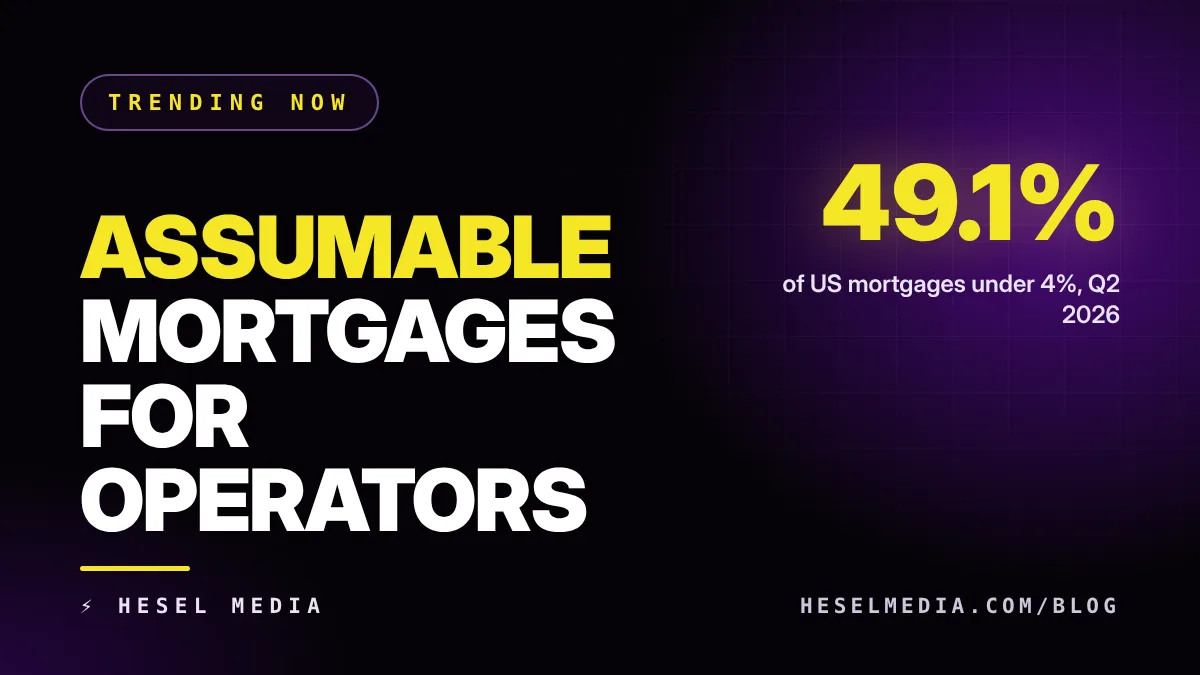
Almost half of all US mortgages still carry a rate under 4%. New loans cost far more. That gap is why more sellers and buyers are asking about assumable mortgages.
Most pages that rank for it are written for homebuyers. This one is written for the operator who talks to motivated sellers every day and needs to know what to do when a seller says, "my loan is assumable."
Key points
- An assumable mortgage is a home loan a buyer can take over from the seller, keeping the same rate, balance and remaining term, with the lender's approval.
- FHA and VA loans are assumable. Most conventional loans are not, because they carry a due-on-sale clause.
- FHA and VA assumptions are built for buyers who will live in the home, so an investor usually cannot assume one for a rental.
- The buyer must cover the equity gap, the difference between the price and the loan balance, with cash or a second loan.
- For an operator, the value is in the exit: a low-rate assumable loan can make a house easier to move to an owner-occupant buyer, and it changes how you structure the offer.
What is an assumable mortgage?
An assumable mortgage is a loan that a new buyer can take over from the current owner. The buyer steps into the seller's loan, with the same interest rate, the same remaining balance and the same payoff date. The lender has to approve the new borrower, and the seller should get a written release of liability.
That last part matters. Rocket Mortgage's VA assumption guide warns that sellers should never finalize an assumption without a formal release of liability from the loan servicer. Without it, the seller can still be on the hook if the new owner stops paying.
Why are assumable mortgages trending in 2026?
Assumable mortgages are trending because so many owners hold loans far below today's rates. A Realtor.com analysis of FHFA data for the second quarter of 2026, reported by National Mortgage Professional, found that 49.1% of outstanding mortgages carried rates below 4%. The same report put the Freddie Mac 30-year average at 7.40% on October 8, 2026.
Many of those owners feel stuck. They do not want to give up a cheap loan, but life happens: a job move, a divorce, an inherited house, a payment they can no longer carry. When a buyer can keep that cheap rate, the house becomes more attractive. That is the whole pitch of an assumable loan.
The lock-in is easing, but slowly. Florida Realtors, citing earlier Realtor.com research, reported that by the third quarter of 2025 more mortgages sat at 6% or higher (21.2%) than below 3% (20.0%). Low-rate loans are still a big share of the market, and they will be for years.
Here is a simple example. Say a seller owes $210,000 at 2.75% with 25 years left. The principal and interest payment is about $969 a month. A brand new $210,000 loan at 7.40% over 30 years runs about $1,454 a month. That is roughly $485 a month the buyer saves by assuming instead of borrowing new.
These are illustration numbers, not a quote, and they leave out taxes, insurance and mortgage insurance.
Which loans are assumable?
Government-backed loans are the assumable ones. FHA and VA loans can be assumed when the lender approves the buyer. Most conventional loans cannot, because their due-on-sale clause lets the lender call the loan when the title transfers.
| Loan type | Assumable? | Buyer must qualify? | Can an investor assume it for a rental? | Notes |
|---|---|---|---|---|
| FHA | Yes, with lender approval | Yes. Redfin cites credit typically 580 or higher and DTI around 43% | No. FHA does not allow assumptions for investment properties | Loan must be current. Buyer takes on the mortgage insurance |
| VA | Yes, with servicer approval (required for loans closed on or after March 1, 1988) | Yes, credit, income and DTI. The buyer does not need to be a veteran | No. Rocket says assumptions cannot be used for speculative investments or secondary vacation properties | 0.5% VA funding fee on the balance. Seller's entitlement can stay tied up |
| Most conventional | Usually no | Not applicable | No | Due-on-sale clause applies |
How does an assumable mortgage work, step by step?
An assumption works like a slower purchase. The buyer applies with the seller's servicer, the servicer underwrites the buyer, the parties close, and the seller is released from the loan.
- Confirm the loan type. The seller's mortgage statement or servicer will say whether it is FHA, VA or conventional.
- Agree on price. The buyer pays the seller the difference between the price and the loan balance.
- Apply with the servicer. The buyer submits income, credit and asset documents. The servicer, not the buyer's favorite lender, makes the call.
- Cover the equity gap. Cash or a second loan. Both the Rocket and Redfin guides list cash or secondary financing as the two options.
- Close and release. The buyer takes over the payments. The seller gets a release of liability in writing.
Plan for time. Rocket says a VA assumption typically takes 45 to 90 days to finalize, compared with 30 to 45 days for a standard purchase. Redfin describes FHA assumptions as taking a few weeks to a couple of months. A seller who needs to be out in two weeks is not an assumption seller.
What is the equity gap, and why does it kill most assumptions?
The equity gap is the price minus the loan balance, and the buyer has to pay it at closing. In our experience, it is one of the biggest reasons assumable deals stall.
Rocket's example shows the problem: a $400,000 sale with $275,000 owed leaves a $125,000 gap. Few owner-occupant buyers have that in cash. A second loan can fill it, but it comes at today's rates, which eats into the savings the buyer wanted in the first place.
Use this quick rule when you look at an assumable deal. Take the monthly savings on the assumed loan and compare it with the monthly payment on whatever fills the gap. If the second loan payment eats most of the savings, the assumption is not worth the wait (often one to three months) for the buyer, and the house will price like any other listing.
Can a real estate investor assume a mortgage?
Usually not through a formal FHA or VA assumption. Both programs are built for buyers who will live in the home. Redfin's FHA guide says investors may not be eligible unless they plan to occupy the property, and Rocket's VA guide says assumptions cannot be used for speculative investments.
This is the part that matters most to operators.
Investors who want to keep a seller's low-rate loan usually look at subject-to deals, where the loan stays in the seller's name and the buyer takes over the payments without lender approval. That is a different structure with different risk, mainly the due-on-sale clause. Read our subject-to guide before you mix the two, and use a local real estate attorney for either one.
How operators use assumable loans in motivated-seller deals
For an operator, an assumable loan is not a way to buy rentals. It is a tool for the exit and for the offer. Here is how we see it fit inside a motivated-seller pipeline.
| Seller situation | What the assumable loan changes | Offer to test |
|---|---|---|
| Low rate, little equity, needs to move | A cash offer leaves nothing for the seller, but the low payment is a selling point for an owner-occupant buyer | Novation or a listing partnership that markets the assumable rate |
| Low rate, some equity, house needs work | Owner-occupant buyers will not assume on a house that needs a rehab | Cash or a creative offer. The assumable rate matters less |
| Low rate, behind on payments | A delinquent FHA loan cannot be assumed until the arrears are cleared | Subject-to with arrears handled at closing, with an attorney |
| VA loan, veteran seller who wants to buy again | A civilian assumption can leave the veteran's entitlement tied to the house | Ask early. A veteran buyer can substitute entitlement with VA Form 26-8106 |
| Conventional loan | Not assumable | Your normal cash, terms or novation menu |
The pattern is simple. An assumable loan raises the value of the house to a buyer who will live there. So the operator who wins is the one with an exit to that buyer, like a novation agreement or a listing partner, and not only a cash buyer list.
The five questions to ask on the first call
You cannot use any of this if your team does not ask about the loan. Add these to your motivated seller qualification questions so your setter collects them on every call.
- Is your loan FHA, VA or conventional? (If they do not know, ask them to check the statement.)
- What is the rate and the monthly payment?
- About how much do you still owe?
- Are you current on payments?
- If it is a VA loan, do you plan to buy another home with a VA loan?
Then tag the answer in your CRM. "Assumable, low equity" and "assumable, has equity" are two different follow-up tracks. The first is a novation or terms conversation. The second may be a straight cash deal where the loan does not matter at all.
Where assumable mortgages do not fit
- Speed. A 45 to 90 day approval does not help a seller facing a foreclosure date next month.
- Big equity gaps. If the buyer has to bring six figures, the rate advantage often disappears.
- Distressed houses. Owner-occupant buyers want move-in ready homes.
- Your own rentals. FHA and VA occupancy rules usually rule you out as the assuming buyer.
- Foreclosures and short sales. Redfin notes an assumption is usually not an option once a home is in foreclosure or a short sale.
Get more motivated sellers on the phone
Knowing loan structures only pays off when sellers are calling you. Hesel runs motivated seller campaigns on Facebook, Google and YouTube, then follows up fast with trained ISAs who qualify every inquiry, so your acquisitions team spends its time on sellers with a real reason to move. We have worked with 700+ investors and handled 96K+ inquiries.
Want to see whether your market is open? Book a strategy call and we will walk through your numbers. If you want to go deeper on terms first, read our guides to seller financing and creative financing structures.
Frequently asked questions
What is an assumable mortgage?
An assumable mortgage is a home loan a buyer can take over from the seller, keeping the seller's rate, balance and remaining term. The lender must approve the buyer, and the seller should get a written release of liability so they are no longer responsible for the loan.
How does an assumable mortgage work?
The buyer applies with the seller's loan servicer, which checks credit, income and debt. If approved, the buyer pays the seller the equity gap in cash or with a second loan, then takes over the payments. VA assumptions often take 45 to 90 days.
How do I know if my mortgage is assumable?
Check the loan type on your statement or call your servicer. FHA and VA loans are generally assumable with lender approval. Most conventional loans are not, because they include a due-on-sale clause that lets the lender call the loan when the home is sold.
Can an investor assume an FHA or VA loan?
Usually not for a rental. FHA does not allow assumptions for investment properties, and VA assumptions cannot be used for speculative investments. Investors who want to keep a seller's low rate often look at subject-to deals instead, which carry due-on-sale risk.
What is the difference between an assumable mortgage and subject-to?
The difference is lender approval. In an assumption, the lender approves the buyer and the loan moves into the buyer's name. In a subject-to deal, the loan stays in the seller's name and the buyer makes the payments without the lender's consent.
Who pays the equity gap on an assumable mortgage?
The buyer pays it. The equity gap is the price minus the loan balance, and the buyer covers it at closing with cash or a second loan. A large gap often slows or stops the sale.
Does a VA seller lose entitlement if someone assumes the loan?
It depends on the buyer. If a qualified veteran assumes and substitutes their entitlement, the seller's entitlement can be restored. If a civilian assumes, the seller's entitlement stays tied to the house until the loan is paid off.
How should a wholesaler use an assumable loan?
Treat it as an exit tool. A low-rate assumable loan makes the house more attractive to an owner-occupant buyer, so it fits a novation or listing partnership. Ask the loan type, rate and balance on the first call so you spot these sellers.
Sources
- National Mortgage Professional: Mortgage rate lock-in, more high-rate loans (Oct 2026)
- Florida Realtors: More mortgages now sit above 6% than 3% (Jan 2026)
- Rocket Mortgage: Are VA loans assumable?
- Redfin: Are FHA loans assumable?
- VA.gov: Form 26-8106, Statement of Veteran Assuming GI Loan (Substitution of Entitlement)