














11 min read · November 1, 2026
Tired Landlords: How to Find Them, Talk to Them and Structure the Offer
 By Esteban AndradeFounder of Hesel Media

The tired landlord is the most business-minded seller you will ever talk to. They aren't panicked, they are finished, and they will do the math on your offer faster than your acquisitions manager. Find them before the third bad tenant does, speak their language, and bring a structure that solves the rental, not just the house.
Key points
- A tired landlord is a rental property owner who is done managing tenants, repairs and vacancies and is open to selling, often with tenants still in place.
- The strongest signals are public: eviction filings where the owner is the plaintiff, open code violations on rentals, an out-of-area mailing address on the tax roll, and long ownership.
- Lead with "you don't have to evict anyone to sell." Buying tenant-occupied is the single strongest hook for this seller.
- Bring more than one offer: cash with tenants in place, seller financing, subject-to or a novation. Taxes are a question for their CPA, never for you.
What is a tired landlord?
A tired landlord is an owner of one or more rental properties who no longer wants the work, risk or cash drain of being a landlord and will consider selling below retail for speed, certainty or a cleaner exit. Our seller research describes this seller as low urgency, low emotion and the most business-minded of any motivation. They are not panicked. They are finished.
They often inherited the property or bought it years ago with a plan that stopped being fun. The trigger is usually one of five things: a tenant stops paying, an eviction, a big repair bill, a property manager quitting, or simply another year of it. For how this seller compares with the other motivations your team works, see types of motivated sellers.
Why tired landlords are worth a dedicated campaign
Tired landlords are worth their own campaign because they combine equity, a rational decision-maker and a deal you can often close without the owner moving out of anything. That changes the operator math in three ways:
- Equity is common. Long-held rentals are often paid down or paid off, which opens cash, seller financing and novation exits that an upside-down homeowner can't support.
- The conversation is shorter. They think like operators. Show the numbers and they decide; hard-sell tactics lose them.
- Portfolio upside. One landlord can own several doors. A good first deal can become a second and third purchase from the same relationship.
The trade-off is urgency. These sellers can wait, so follow-up decides who gets the contract. Hesel's playbook for this seller is built on patience and numbers, not pressure.
Where to find tired landlords: the signals and the data
You find tired landlords by stacking public signals of rental pain on top of ownership data, then working the owners who show two or more. Here is where each signal lives:
| Signal | Where to find it | How fresh | Watch out for |
|---|---|---|---|
| Eviction filing, owner as plaintiff | County court or clerk case search; Eviction Lab for market-level trends | Weekly to monthly, by court | Contact the landlord, never the tenant. Online access varies by state and court. |
| Open code violation on a rental | City open-data portals or a public records request | Daily to monthly, by city | Owner-occupants get violations too. Filter for non-owner-occupied properties. |
| Absentee owner | County assessor or tax roll: mailing address different from the property address | Updated with tax records | LLCs and registered agents hide the real owner. Skip trace the manager or member. |
| Long ownership and likely equity | Assessor or recorder: last sale date and recorded mortgages | Static until a sale or loan records | Equity is not motivation. Use it as a tiebreaker. |
| Tax delinquency | County treasurer or tax collector | Usually annual | Heavily marketed list. Stack it with another signal. |
| Repeat rental listings or manager churn | Rental listing sites and local property manager signs | Real time | Manual work. Best for multifamily and small portfolios. |
| Inbound form answer "Tired Landlord" | Your own Meta and Google campaigns | Real time | Highest intent. Needs a call within minutes. |
For market context, the Eviction Lab at Princeton publishes monthly eviction filing counts for 11 states and 43 cities, with its location table last updated October 1, 2026. It shows where filings are rising. It does not name landlords, so the actual plaintiffs come from the court docket. For a step-by-step on code data, see our guide to building a code violation list.
A simple scoring rubric to rank your list
Score every owner by how many independent pain signals they show, and work the highest scores first. These are starting weights to test against your own contracts, not a proven model:
- Eviction filing as plaintiff in the last 12 months: 3 points
- Open code violation on a non-owner-occupied property: 3 points
- Vacant rental: 2 points
- Mailing address outside the county or state: 2 points
- Tax delinquent: 2 points
- Owned 10 or more years: 1 point
- Owns three or more doors in your market: 1 point
Call or mail owners at 5 points and up first. After 90 days, compare which signals showed up in the owners who signed. Then reweight. The point of the rubric is not the numbers; it is forcing your team to learn which signals actually turn into contracts in your market.
How to talk to a tired landlord
Talk to a tired landlord like a business partner reviewing a bad asset: short, numbers first, no sympathy theater. The sentence from our seller research that makes this seller feel understood is: "Leave the tenants, the lease and the mess to us. You don't have to evict anyone to sell."
Questions that qualify the property and the person
- What's got you thinking about selling this one now?
- Is it occupied, vacant or in the middle of an eviction? Lease or month-to-month, and when does it end?
- What does it rent for, and is the tenant current?
- Roughly what comes in and goes out each month once you count taxes, insurance, repairs and vacancy?
- Roof, HVAC and anything you have been putting off?
- Is there a mortgage, and roughly what is owed?
- If we close on your timeline, take it as-is with the tenant, and cover closing costs, what do you need to walk away with?
- What would you do with the money? (If they say "buy another property" or "taxes," point them to their CPA.)
Hesel's inbound script for landlords and vacant owners adds one move that works: add up, out loud, what the property has cost them so far. A seller who hears their own repair, vacancy and turnover costs in one number usually gets to the decision on their own.
Example math: the landlord's real hourly wage
One of the seller ad angles Hesel's media buyers run reframes the rental as a job that pays about $8 an hour. Here is how to run that math with a seller. Illustrative numbers, not a client example:
- Rent: $1,600 a month.
- Mortgage, taxes and insurance: $1,150.
- Repairs, turnover and vacancy reserve: $300.
- What is left: $150 a month.
- Hours spent on calls, repairs, showings and paperwork: about 20 a month.
- Real wage: $150 divided by 20 hours = $7.50 an hour.
Hesel's media buyers list the tired landlord angle among the five seller ad angles they label "proven" in 2026.
Objections you will hear, and honest answers
- "Will I have to evict before you'll buy?" No. You buy with the tenant in place and underwrite the current rent and lease.
- "What about the security deposits and the lease?" Deposits are credited and leases are transferred at closing, handled by the title company and your attorney under your state's landlord-tenant law.
- "What's the tax hit?" That is a question for their CPA. You can mention that options exist, then stop. Never give tax advice.
Offer structures that fit a tired landlord
The right structure depends on equity, the mortgage and whether the landlord wants a lump sum or monthly income, so bring at least two options to every appointment:
- Cash with tenants in place. The default and the strongest hook. Underwrite on current rent, lease terms and deferred maintenance. Fast and simple for the seller.
- Cash with the property delivered vacant. A higher price if the seller handles move-out lawfully. Never pressure a tenant, and let the seller's attorney run any eviction.
- Seller financing. Fits a landlord who wants monthly income without the work. The IRS treats a sale with at least one payment after the year of sale as an installment sale, where gain is generally reported as payments come in, but depreciation recapture is reported in the year of sale. Their CPA confirms the details.
- Subject-to. Fits low equity with an existing loan. You take title while the loan stays in place. Disclose the due-on-sale risk in writing and use an attorney and a loan servicer.
- Novation. Fits a clean house with a tenant leaving or month-to-month and a seller who wants closer to retail. See how one Hesel client closed a novation on a tenant-occupied property. That was one of our best results, not a typical one. Outcomes depend on market, budget, offer and follow-up speed.
- Portfolio purchase. If they own several doors, price the package. Some landlords would rather sell everything once than sell one door at a time.
When a landlord says they want to "roll it into another property," that is a like-kind exchange conversation for their tax advisor. The IRS says such exchanges apply to "real property used for business or held as an investment," and that property "held primarily for sale" does not qualify. Use "defer," never "avoid," and let the CPA lead.
For more structures, see our guide to creative real estate financing strategies.
Outreach rules that keep you out of trouble
Tired landlord outreach is still telemarketing and advertising, so the same rules apply as for any seller. Three that matter most:
- Do Not Call. If you cold call, the FTC says you "must synchronize your lists with an updated version of the registry at least every 31 days." If a seller submits an inquiry, the FTC says "the company can call for three months."
- Ad copy. Meta's policy says ads "must not contain content that asserts or implies personal attributes," including vulnerable financial status. Write "Rental owners: sell with tenants in place," not "Are you a broke landlord?"
- Permission for calls and texts. Hesel's rule is to call or text only people who gave permission, scrub cold lists, and stop when someone says stop. Confirm your state's rules with counsel.
How Hesel runs tired landlord campaigns
Hesel treats "tired landlord" as its own seller motivation from the ad to the first call, so the ad, the form and the rep make the same promise. Here is the process detail:
- The form asks. Hesel's instant-form SOP asks "Why are you looking to SELL your property?" with eight options, and "Tired Landlord" is one of them. That answer tags the inquiry before anyone calls.
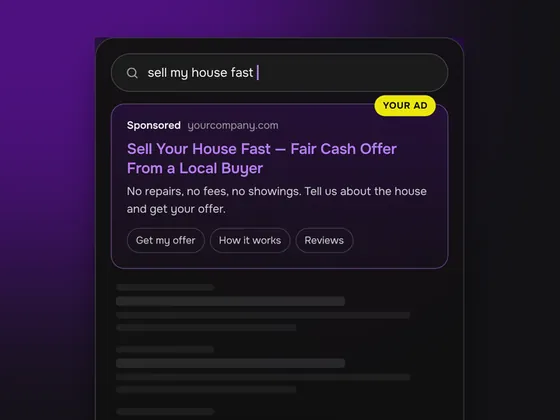
- One ad per motivation. A creative framework Hesel uses maps 15 seller motivations, including tired landlord, vacant, code violations and out-of-state owner, and builds distinct ads for each instead of one generic "we buy houses" ad.
- Occupancy on the first call. The ISA checklist captures owner-occupied, tenant or vacant, plus lease or month-to-month, so the acquisitions manager walks in knowing whether the tenant-in-place offer leads.
- Neutral tracking. Our tracking standard: if conversion signals go back to Meta, keep them neutral and never send fields that describe a seller's hardship.
Want tired landlords calling you instead?
Lists tell you who might be tired. Inbound tells you who is tired today. A landlord who fills out a form after a bad month is a different conversation from one who gets your fourth postcard.
Hesel runs motivated seller campaigns on Meta and Google with motivation-specific ads, plus ISA follow-up and appointment setting that books landlords with your acquisitions team after occupancy, lease and numbers are on the record.
See if your market fits: book a market viability call. If the math doesn't work, we will tell you on the call.
Frequently asked questions
What is a tired landlord in real estate?
A tired landlord in real estate is a rental owner who no longer wants to manage tenants, repairs and vacancies and is open to selling, often below retail, for speed and certainty. They are usually business-minded, frequently own the property with equity, and often prefer to sell with tenants still in place.
How do you find tired landlords?
You find tired landlords by stacking public signals: eviction filings where the owner is the plaintiff, open code violations on rentals, out-of-area mailing addresses on the tax roll, tax delinquency and long ownership. Score owners by how many signals they show, then reach the highest scores first through compliant calls, mail or inbound ads.
Can you buy a rental property with tenants in it?
You can buy a rental property with tenants in it. The buyer takes over the existing lease and the security deposits are credited at closing, handled by the title company under state landlord-tenant law. Buying tenant-occupied is often the strongest offer for a tired landlord because they don't have to evict anyone to sell.
What is a tired landlord list?
A tired landlord list is a set of rental property owners filtered for signs of fatigue, such as eviction filings, code violations, vacancy, absentee ownership and long holding periods. It is a starting point for outreach. The best lists stack two or more signals per owner and are scored and re-weighted against which owners actually sign contracts.
What offers work best for tired landlords?
The offers that work best for tired landlords are cash with tenants in place, seller financing for owners who want monthly income, subject-to for low-equity properties with a loan, novation for clean houses, and portfolio purchases for owners with several doors. Bring at least two options and let the landlord compare the numbers.
Should I talk to a tired landlord about taxes?
You should not give a tired landlord tax advice. You can mention that installment sales and like-kind exchanges exist and that the word is "defer," not "avoid," then send them to their CPA. Tax treatment depends on their depreciation, basis and plans, which only their advisor can judge.
Can I cold call landlords from eviction records?
You can call landlords from eviction records only within telemarketing rules. The FTC requires sellers who must use the Do Not Call Registry to scrub lists at least every 31 days, and state rules can be stricter. Contact the landlord, never the tenant, and confirm your calling and texting practices with counsel.